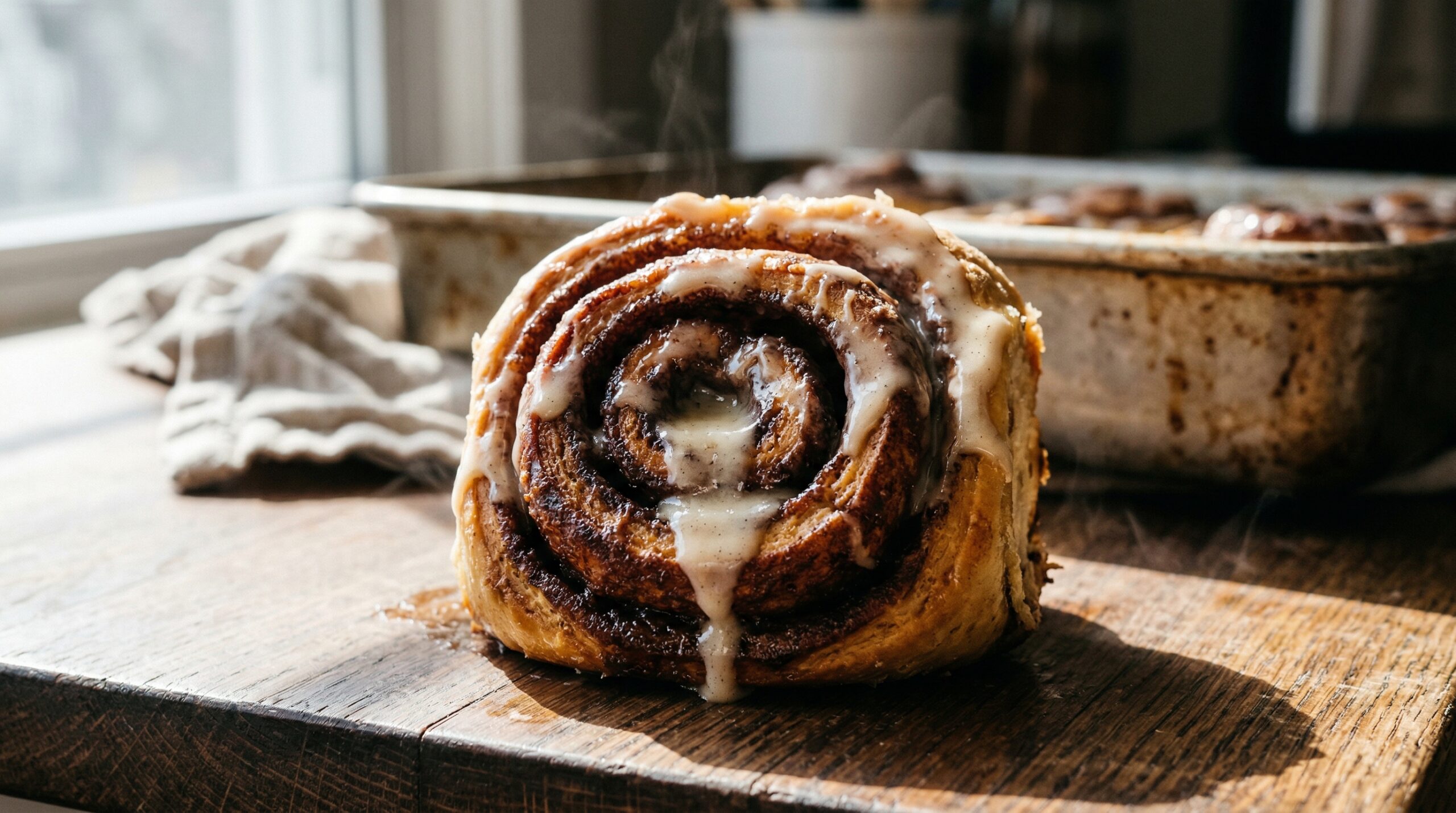
Ingredients
Equipment
Method
Mix the Dough
- Dissolve the active dry yeast in warm water and allow it to activate until foamy.
- In a stand mixer, combine the milk, granulated sugar, cubed butter, salt, and eggs.
- Integrate 2 cups of the flour and mix until a smooth, smooth foundation is achieved.
- Add the activated yeast and gradually incorporate the remaining flour until a soft, pliable dough forms.
The Kneading and Primary Rise
- Transfer the dough to a lightly floured surface. Execute a manual knead for 10 minutes to develop the gluten structure.
- Place the dough in an oiled vessel, cover, and allow for a primary rise until the volume has doubled, approximately 40 to 60 minutes.
Fill & Roll the Cinnamon Rolls
- In a food processor, pulse the brown sugar, granulated sugar, flour, cinnamon, and nutmeg until integrated.
- Pulse in the chilled butter cubes until the mixture achieves a coarse, sandy crumb texture.
- Roll the risen dough into a 10x14-inch rectangle. Distribute the filling crumb evenly across the surface.
- Roll up tightly in a jelly-roll fashion, starting from the narrow edge. Pinch the ends to seal the seam.
Rise & Bake
- Preheat the oven to 375°F. Slice the dough cylinder into uniform 1-inch pieces.
- Arrange the rolls cut-side up in a 13x9-inch baking dish coated with vegetable oil.
- Cover and allow for a secondary rise of 30 minutes.
- Brush the rolls with 1 tablespoon of half and half to promote a beautiful golden crust.
- Bake for 25 to 30 minutes until the crumb is set and the exterior is golden.
Drizzle the Vanilla Glaze
- Whisk together the confectioners’ sugar, corn syrup, vanilla, and half and half until a smooth, glossy glaze is formed.
- Drizzle the glaze over the warm rolls and serve immediately while still warm.